How forensic firearms and tool mark examiners work: the marks guns leave on bullets and cartridge cases, class versus individual characteristics, comparison microscopes and databases, tool marks at crime scenes, and the scientific criticism of the field.
When a gun is fired, it leaves marks on the bullet and cartridge case. When a crowbar forces a door, it leaves marks on the frame. Firearms and tool mark examination is the forensic discipline that compares these marks to link evidence to a weapon or tool. It's powerful, but it has also faced serious scientific scrutiny.
Marks on bullets
Most modern gun barrels are rifled: they have spiral grooves cut inside to spin the bullet. The raised parts between grooves are called lands. As a bullet travels down the barrel, it picks up impressions of these lands and grooves.
- Class characteristics are shared by many guns of the same make and model: the number of lands and grooves, their width, and the direction of twist. These can narrow down the type of weapon.
- Individual characteristics are fine striations caused by tiny imperfections in a particular barrel from manufacture and wear. Examiners compare these to judge whether two bullets were fired from the same gun.
Marks on cartridge cases
Cartridge cases often provide better evidence than bullets, which can be damaged on impact. Examiners look at:
- the firing pin impression;
- breech face marks, made as the case is pushed back against the gun's breech;
- extractor and ejector marks from the mechanisms that remove spent cases.
How comparisons are made?
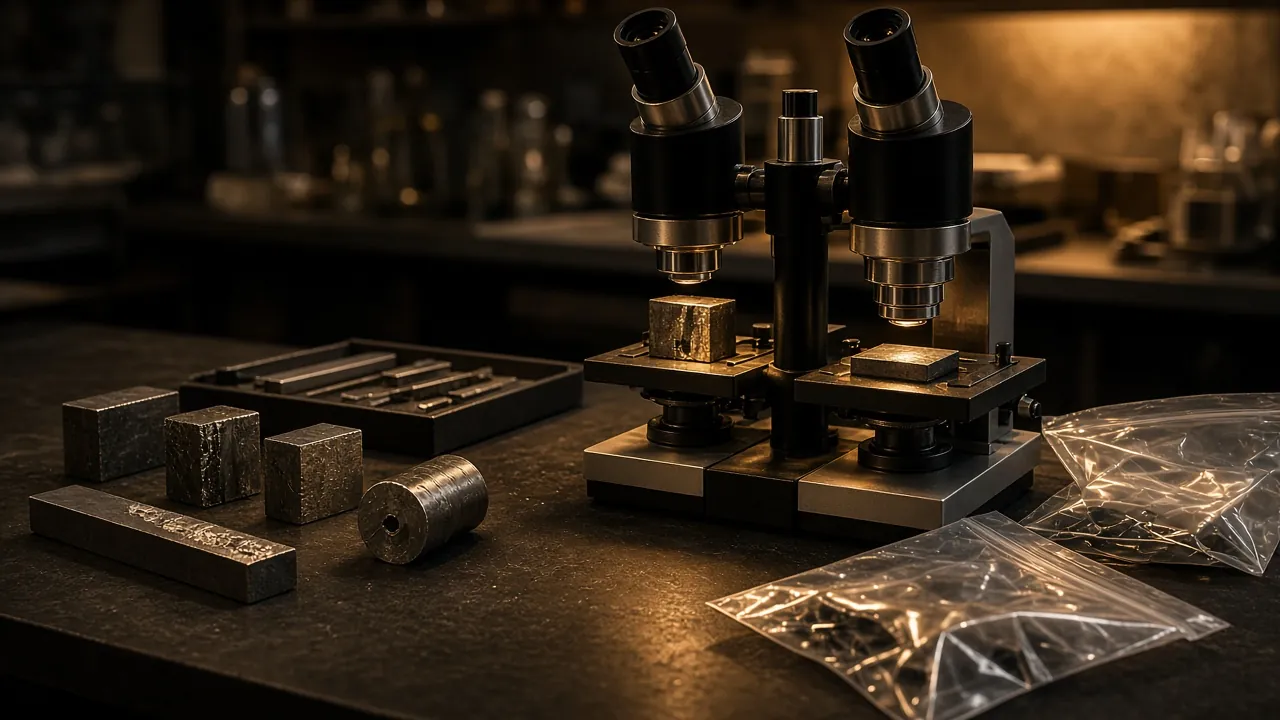
Examiners test-fire a suspect weapon into a water tank or similar to recover reference bullets and cases. They then use a comparison microscope, which shows two items side by side in one view, to compare the marks.
Ballistics databases help link crimes. In the US, the National Integrated Ballistic Information Network (NIBIN) holds images of cartridge cases. In the UK, the National Ballistics Intelligence Service (NABIS) links firearms incidents across police forces. Database hits are leads that an examiner must then confirm.
Tool marks
The same principles apply to tools. A screwdriver, bolt cutter or crowbar has its own imperfections, and examiners can compare marks at a scene with test marks made by a suspect tool. Tool mark evidence is common in burglary investigations.
The scientific criticism
Traditionally, examiners declared a "match" based on their trained judgement that marks agreed sufficiently. Two influential US reports raised concerns:
- The National Research Council's 2009 report, Strengthening Forensic Science in the United States, said the field needed more research on the variability of marks and the reliability of conclusions.
- The 2016 PCAST report, from the US President's Council of Advisors on Science and Technology, found that at the time there was only one appropriately designed study of firearms comparisons, and called for more research to establish error rates.
Since then, further studies have measured examiner accuracy, with results debated by scientists and lawyers. Courts in some US states have limited how strongly examiners may express their conclusions, for example barring claims of certainty.
Improving the field
- 3D imaging and statistical methods, supported by organisations such as the US National Institute of Standards and Technology (NIST), aim to measure similarity objectively.
- Blind testing and proficiency tests check examiner performance.
- Regulation: in England and Wales, the Forensic Science Regulator now has statutory powers, and forensic providers must follow its Code of Practice.
The bottom line
Firearms and tool mark evidence can be valuable, especially for linking crimes. But it involves expert judgement, and its conclusions should be weighed carefully, with clear statements of uncertainty rather than claims of absolute certainty.
Sources and further reading
- National Academies: Strengthening Forensic Science in the United States (2009)
- PCAST: Forensic Science in Criminal Courts (2016)
- NIST: Forensic science
- Forensic Science Regulator
- NABIS
Facts checked on 20 October 2026. Spotted an error? Tell us and we will correct it.
Frequently asked questions
What should you know about Marks on bullets?
Most modern gun barrels are rifled : they have spiral grooves cut inside to spin the bullet. The raised parts between grooves are called lands.
What should you know about Marks on cartridge cases?
Cartridge cases often provide better evidence than bullets, which can be damaged on impact.
How comparisons are made?
Examiners test-fire a suspect weapon into a water tank or similar to recover reference bullets and cases. They then use a comparison microscope , which shows two items side by side in one view, to compare the marks.
What should you know about Tool marks?
The same principles apply to tools. A screwdriver, bolt cutter or crowbar has its own imperfections, and examiners can compare marks at a scene with test marks made by a suspect tool.